Understanding the cause of your back pain is the key to proper treatment.
There are many different underlying conditions that cause back pain. The more common causes of back pain are described below. Don’t try to make your own diagnosis. A trained chiropractor that deals with back pain complaints on a daily basis will know what to look for and what questions to ask you to determine the underlying cause.
1. Muscle strains and muscle spasms are the most common cause of low back pain. Patients may or may not remember the initial event that triggered their muscle spasm. Back pain from muscle spasms can be incredibly painful and feel like nerve pain when the muscle tighten and twitch around a key nerve such as the sciatic nerve.
2. A ruptured intervertebral disc, also called a herniated disc, is another common cause of back pain. The terms ruptured, herniated, slipped and bulging disc don’t really have precise definitions to distinguish one from another and are often used somewhat interchangeably to describe protruding disc material. It is important to note that a large percent of the population is walking around with bulging discs that cause no symptoms, so not every herniated disc warrants treatment or intervention.
3. Discogenic back pain is the result of damage to the intervertabral disc, but without disc herniation. Diagnosis of discogenic back pain may require the use of a discogram.
4. Spinal stenosis causes a lot of back pain in the elderly. As we age, the spinal canal can become constricted from arthritis and other conditions. If the spinal canal becomes too tight, back pain can be the result.
5. Arthritis most commonly affects joints such as the knees and fingers. However, arthritis can affect any joint in the body, including the small joints of the spine. Arthritis of the spine can cause back pain with movement.
6. Spondylolisthesis causes back pain because adjacent vertebra become unstable and begin to "slip." The most common cause of spondylolisthesis are degenerative changes causing loss of the normal stabilizing structures of the spinal column.
As stated earlier, backaches are hard to self-diagnose. The causes listed above are just a few of more common possibilities. If you suffer from acute or chronic backaches, consult a qualified chiropractor for a complete exam.
Showing posts with label low back pain. Show all posts
Tuesday, December 6, 2011
Tuesday, September 27, 2011
Take Control of Chronic Childhood Ear Infections
Help! I Think My Child Has an Ear Infection
It's 2 am and the crying has only gotten progressively worse across the past hour. You are pacing the downstairs hallway trying anything to soothe your inconsolable 10-month old so that your 5 and 8 year old kids can get some sleep upstairs. Your plan is to call the doctor's office the moment they open — seven hours from now!
Although your infant cannot tell you what is wrong, your intuition says it is another middle ear infection. The statistics would suggest that your hunch is probably right.
Earaches are the #1 Reason for Visits to the Pediatrician's Office
As a parent, that probably comes as no surprise. But, you may be surprised to learn that both the American Academy of Pediatrics and the Academy of Family Physicians recommend a 'watchful waiting' or 'wait and see' approach to acute ear infections.
Antibiotics for Ear Infections?
Research published in the prestigious Journal of the American Medical Association demonstrated that there was no difference in fever, otalgia (pain) or number of future visits between kids that were given an antibiotic prescription and those that were not. As it turns out, antibiotics only outperform the body's own immune system in a handful of cases. No Side Effects and Low Recurrence Rate
At the same time, numerous studies of manipulative therapies including chiropractic care have shown remarkable results without the side effects of antibiotics. A groundbreaking 1997 study of 332 kids ages 27 days to 5 years indicted a strong correlation between chiropractic adjustment and the resolution of otitis media (the technical term for a middle ear ache). Just to highlight one finding — there were 104 kids in the group classified as having 'chronic' otitis media. This group of kids got 5 chiropractic adjustments each. Across the next six months the recurrence rate among this group was only 16%!
Let's put that data into more human terms. That means that 84% of these kids classified as having chronic ear infections went six months without having another one after just 5 adjustments. A full half year devoid of screaming in the middle of the night, lost sleep and anguish of watching your child suffer for 84% of the parents.
Care and Prevention of Ear Infections
The prior study published in a chiropractic journal spurred further research into the uses of chiropractic care for acute and chronic ear infections. The critical questions was - how would chiropractic fare head-to-head with standard pediatric care? A 2003 study published in a pediatric medicine journal comparing children receiving manipulative therapy and those receiving standard pediatric care, found that those who received manipulative therapy had fewer episodes of Acute Otitis Media (AOM), fewer surgical procedures and had higher rates of normal tympanograms. This amazing news for parents has been validated and confirmed numerous times since then. The International Chiropractic Pediatric Association (ICPA) even maintains a webpage of all the published research studies done on children's ear infections and the role of chiropractic care in treatment and prevention. The last time I looked there where 25 separate studies listed. You can view the full list at: Ear Infection (Otitis Media)
All this data and research is great, but at the end of the day what matters to parents is getting their own child out of pain and on a path to a success in school, sports and life without the constant interruption of ear infections. Donít spend another sleepless night pacing the halls with a screaming toddler in your arms. Call us now and make an appointment for a consultation.
Don't wait until another ear infection strikes. Prevention is always the better option. Besides, when your child is in pain, your anxiety level as a parent goes way up. We want you to be able to ask all your questions and get all the facts at your own pace and not feel pressured to make a decision or start treatment because your child is screaming. Of course, if your child does have current symptoms, we want to see both of you as soon as possible.1. Spiro DM, Tay K, Arnold DH, et al. Wait-and-see prescription for the treatment of acute otitis media: a randomized controlled trial. Journal of the American Medical Association 2006; 296(10): 1235-1241.
2. Fallon, JM. Journal of Clinical Chiropractic Pediatrics Vol 2, No. 2 1997 p.167-183.
3. Mills MV, Henley CE, Barnes LLB, Carreiro JE, Degenhardt BF. The use of osteopathic manipulative treatment as adjuvant therapy in children with recurrent acute otitis media. Archives of Pediatrics and Adolescent Medicine 2003; 157(9): 861-866.
Tuesday, September 20, 2011
Some Surprising Statistics About Back Pain
Suffering from Back Pain?
You are not alone. Back pain relief is just one component of chiropractic care, but it is often a patient's first introduction. Back pain is horribly debilitating affecting all aspects of work and personal life. Surprising Facts about Back Pain:
• Back pain is the number one disability for those under age 45.
• In the United States of America alone, there is an expected 31 million people with lower back pain at any given time.
• Back pain runs second, after only the common cold, as the top reason for visiting a healthcare provider in the United States.
• Experts place the likelihood of any person to experience some type of back problem in their lifetime at about 80%. That's four out of every five people!
• Over 50 billion dollars are spent per year in the pursuit of clearing up cases of back pain.
• Around 30 to 40 percent of all workplace absences are due to back pain.
• Approximately one quarter of U.S. adults reported having low back pain lasting at least one whole day in the past three months, and 7.6 percent reported at least one episode of severe acute low back pain within a one-year period.
• One-half of all working Americans admit to having back pain symptoms each year.
• Approximately 2 percent of the U.S. work force is compensated for back injuries each year.
• Lower back pain accounts for two thirds of all back pain-related cases.
• More than two-thirds of back strains are caused by lifting and other exertions like pulling and pushing.
• Most cases of back pain are mechanical or non-organic — meaning they are not caused by serious conditions, such as inflammatory arthritis, infection, fracture or cancer.
The key to proper treatment of back pain is to understand the cause. Remember, pain is always a sign that something else is wrong and if continually ignored may lead to more serious harm. Chiropractors are experts in assessing the root cause of your back pain and putting you on the right course to recovery.
.
.
Tuesday, August 23, 2011
AN ADJUSTMENT IN YOUR GOLF GAME
Neck and Shoulder Pain from Golfing
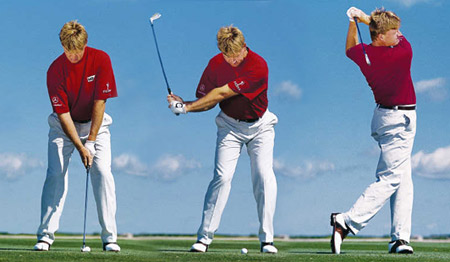
Chiropractic care is standard for many pro golfers and increasingly for many Senior Golfers as well. Professional golfer Lori West attributes the reason she’s playing today to chiropractic. Nearly two decades ago, she began visiting a chiropractor for pain in her shoulders and neck. According to West, the care has infinitely improved her golf game.A Good Golf Swing
The problem is that the golf swing, in and of itself, isn’t conducive to having a healthy back. To have a good swing you create tension in your spine. (This enables you to get good distance). The tension comes from the hips stopping and the shoulders continuing to rotate. Basically, you make a coil. You’re uncoiling when you start your downswing. Since that’s an awkward movement for your back, many golfers end up with lower back problems.Chiropractic advice and Stretches for Golfers:
• Before your game, do some
basic stretches.Stretch out hamstrings and
groin area.
• Put a club across your
shoulders and lean left
and right.
• Get in a position of where
you would be in a swing
and bend left and right.
• Grab a club behind your
back and raise it up,
stretching your
shoulder muscles.
• Grab the club backwards –
so if you normally swing
right-handed, you’d grab it
like you’d be swinging
left-handed — and take 10 practice swings that way. You’re
stretching different muscles and it will help you loosen up
considerably.
• Do neck stretches. Stiff neck muscles inhibit the rest of the body
from turning freely.
Flexibility and Golf
Anything that helps your flexibility eventually helps with your game. As you get older, your swing naturally shortens since the muscles aren’t as supple. During the winter, work on stretching the muscles of the arms, shoulders and back. Flexibility is very important for older golfers.Improved Balance for Golf
Also, you have to have good balance if you want to hit the golf ball consistently. A healthy spine is paramount to proper balance and posture. Improve your balance and you’ll improve your consistency. In needed, orthotic stabilizers for your shoes can help improve balance so your swing is better.
Chiropractors care for your body as a whole, not just the back. So if your golf game is feeling out of sync, chiropractic may be just the very adjustment that your body and game needs!
.
.
Subscribe to:
Posts (Atom)